
 336h 55m
Fermented Sweet Pepper Tabasco Sauce
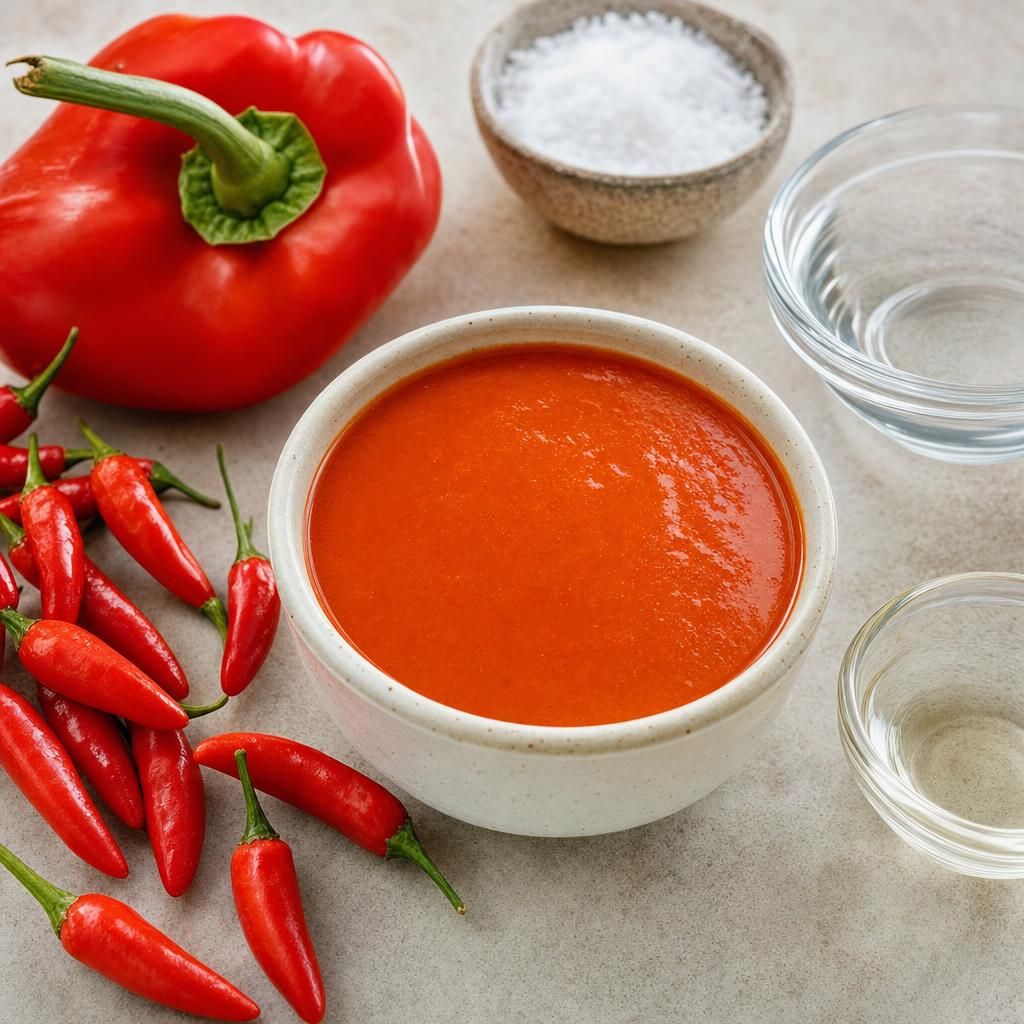
Fresh Tabasco peppers bring bright, assertive heat, while red bell pepper adds sweetness and rounds out this naturally fermented sauce. A final splash of white vinegar makes it lively, smooth, and pourable.
Shopping options
Cook this recipe
- fresh Tabasco peppers-250 g
- Red bell pepper-150 g
- Filtered water-200 ml
- White vinegar, 5% acidity-120 ml
- Kosher salt-18 g
Wash your hands and thoroughly clean the equipment. Wearing gloves, rinse and stem the Tabasco peppers, then cut them in half lengthwise. Prepare and dice the red bell pepper. Weigh the peppers after trimming: you need 250 g Tabasco peppers and 150 g bell pepper.
Wear gloves when handling the hot peppers, avoid touching your face, and wash hands, utensils, and surfaces afterward.
Toss the peppers with 12 g kosher salt in the mixing bowl. Let stand for 20 minutes, stirring once. The produce salt basis is 3% of the combined prepared pepper weight: 400 g peppers × 0.03 = 12 g salt.
Dissolve the remaining 6 g salt in 200 ml filtered water. This additional salt makes a matching 3% brine by water weight, preventing the added water from diluting the salt level.
Pack the peppers and their released juices into the jar. Add all the brine, press the peppers down, and place the fermentation weight on top. Keep every piece below the liquid, with at least 1½ inches of headspace above the brine.
Keep every pepper piece below the brine and maintain the stated headspace; do not seal the actively fermenting jar airtight.
Fit the lid loosely so gas can escape; do not tighten it airtight. Set the jar on the tray, away from direct sunlight, at room temperature, ideally 65–75°F (18–24°C).
Keep the lid loose so fermentation gas can escape; never tighten an actively fermenting jar airtight.
Ferment for approximately 7–14 days. Every day, briefly loosen and lift the lid to release trapped gas, then replace it loosely. Check that the peppers remain submerged, pressing the weight down with a clean spoon if necessary. Cloudy brine and bubbles are normal.
Release gas daily and keep the peppers submerged; discard the batch if fuzzy or colored mold, unusual slime, or a rotten smell appears.
Calibrate the food pH meter and check a representative mashed sample of peppers and brine. Verify pH 5.2 or lower within 24 hours and below 4.6 within 48 hours. Discard without tasting if either deadline is missed; do not rescue failed fermentation with vinegar. Discard tested samples. Continue monitoring until the recipe's final pH target of 4.5 or below is reached.
Start acidity measurements during the first day, not day 5.
Finish fermentation when bubbling has noticeably slowed, the aroma is pleasantly tangy, and the peppers have developed clear acidity, with the brine at pH 4.5 or below. This usually takes 7–14 days. Do not rely on the calendar alone.
Use the pH reading as the safety endpoint rather than relying on bubbling, aroma, or the calendar alone.
Drain the fermented peppers, reserving exactly 60 ml (¼ cup) brine. Discard the remaining brine. Blend the peppers, reserved brine, and all 120 ml white vinegar for 1–2 minutes, until very smooth. The vinegar is added only now, after fermentation.
Wear gloves and keep the blender covered to prevent hot pepper splashes; avoid touching your face.
Push the sauce through a fine-mesh strainer with a clean spoon, leaving tough skins and seeds behind. Check that the finished sauce remains at pH 4.5 or below, then transfer it to the clean bottle and refrigerate immediately.
Refrigerate the finished sauce immediately at 40°F (4°C) or below, and discard it if mold, off-odors, or other spoilage develops.
Let the sauce mellow in the refrigerator for 24 hours for the best flavor. Shake before serving in 1-teaspoon portions alongside tacos, beans, roasted vegetables, and other savory dishes.
How did it turn out?
Rating and review tools are unavailable right now.