
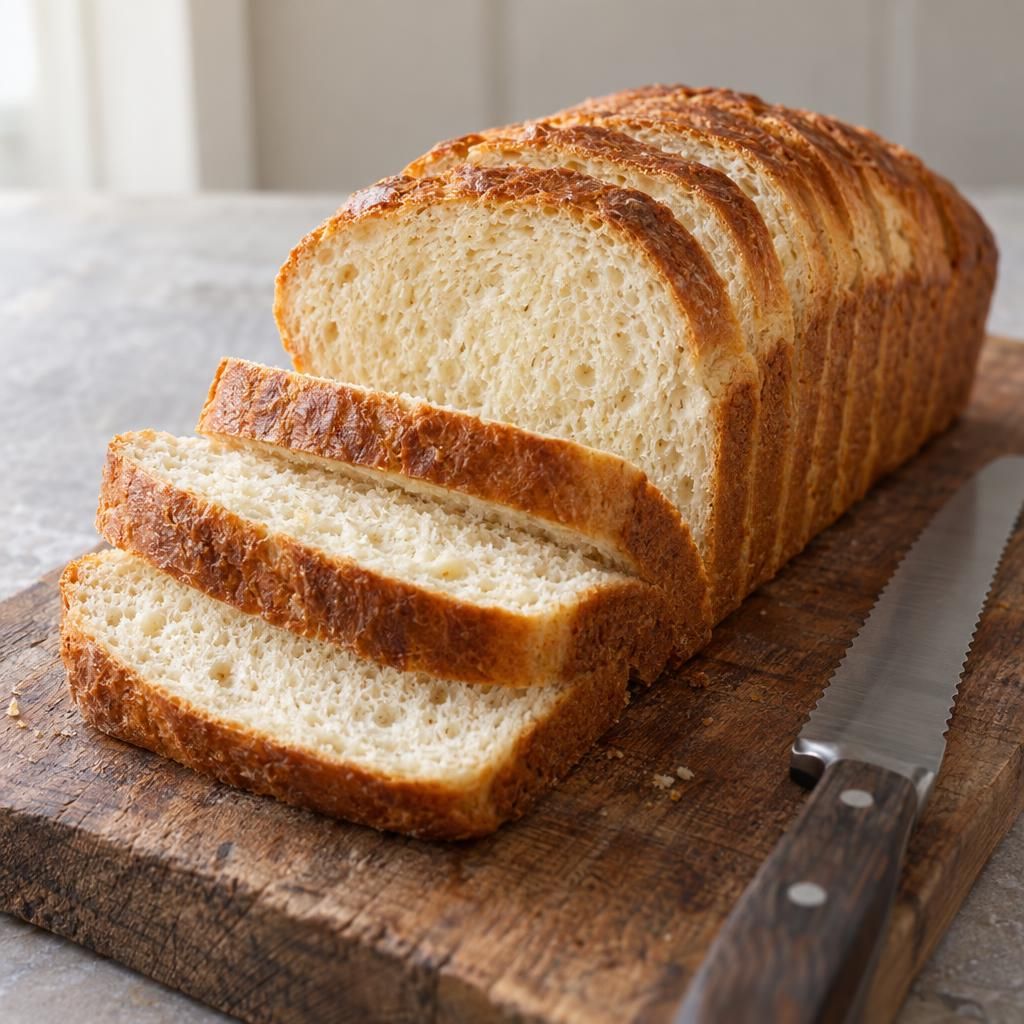
Soft Gluten-Free Sandwich Loaf
A tender, honey-sweetened sandwich loaf enriched with milk, eggs and butter. Its soft, cohesive crumb slices neatly once completely cooled.
- Gluten-Free
- gluten-free bread
- loaf bread
- loaf pan
- sandwich bread
- Vegetarian
- yeast bread
- Cuisine
- International
Shopping options
Check ingredients to include themPackage used · most used first
Whole milk · 1.5 Cup
Kroger® Vitamin D Whole Milk 16 fl. oz. Bottle
75%
Details
Gluten-free bread flour formulated for yeast baking, containing xanthan gum · 400 Gram
King Arthur Bread Flour, Gluten-Free, 1:1 Flour Replacement
Sale
44%
Details
Instant yeast · 2.25 Teaspoon
Fleischmann's® Fast-Acting RapidRise® Instant Yeast Packets
Sale
33%
Details
Honey · 3 Tablespoon
Kroger® Clover Honey Bear
Sale
19%
Details
Large eggs · 2 Each
Kroger® Grade A Large White Eggs
17%
Details
Unsalted butter · 5 Tablespoon
Kroger® Unsalted Butter Sticks
16%
Details
Fine salt · 1.25 Teaspoon
Morton Plain Table Salt, Non-Iodized Salt, 26 oz
1%
Details
Cost Summary
· only what you use
per serving · 12 servings
Cook this recipe
- Gluten-free bread flour formulated for yeast baking, containing xanthan gum-400 grams
- Whole milk-1 1/2 cups
- Unsalted butter-1/4 cup + 1 tablespoon
- Honey-3 tablespoons
- Large eggs-2 each
- Instant yeast-2 1/4 teaspoons
- Fine salt-1 1/4 teaspoons
Wash your hands and clean the work surface. Grease the bottom and sides of the loaf pan with the measured 1 tablespoon softened butter. Set the eggs out while preparing the other ingredients.
Use a clean pan and work surface, and prevent contact with wheat flour to avoid gluten cross-contact.
Warm the milk in the saucepan over low heat until it reaches 100–110°F. Remove from the heat. The milk should be warm, not hot.
In the stand mixer bowl, whisk together the gluten-free bread flour, instant yeast and salt using the paddle on low speed. Add the warm milk, eggs, honey and remaining 4 tablespoons melted butter.
Do not taste the raw dough; raw flour and eggs can carry harmful bacteria. Wash hands and clean utensils and surfaces after contact.
Mix on low speed for 1 minute, scraping the bowl with the spatula. Increase to medium speed and beat for 4 minutes, stopping once to scrape the bowl. The dough should be smooth, thick and very sticky, resembling a stiff batter rather than kneadable wheat dough. Do not add flour to make it less sticky.
Scrape the dough into the prepared pan, pressing it into the corners and smoothing the top with the spatula. Cover loosely with plastic wrap, leaving room for expansion. Let rise in a warm, draft-free place, ideally 75–80°F, for approximately 45–75 minutes. It is ready when visibly puffy and the center reaches just above the pan rim. Do not wait for it to double.
While the loaf rises, place an oven rack in the lower-middle position and preheat the oven to 350°F. Remove the plastic wrap when the loaf is ready and gently transfer the pan to the oven.
Use oven mitts when transferring the pan to the preheated oven.
Bake for 55–65 minutes. If the top becomes deeply golden before the center is done, tent it loosely with foil after about 35 minutes. The finished loaf should have a firm, golden-brown crust, and a thermometer inserted into the center should register 205–210°F. If the center is below 205°F, continue baking and check again after 5 minutes.
Use oven mitts around the hot pan and foil; clean the thermometer probe before and after checking the loaf.
Cool in the pan for 10 minutes, then carefully turn the loaf out onto the wire rack. Leave it upright to cool completely, at least 3 hours. Do not cover it while it is warm; trapped steam can make the crust and crumb gummy.
Use oven mitts when handling the hot pan and turning out the loaf.
Once completely cool through the center, use a serrated knife with a gentle sawing motion to cut the loaf into 12 even slices, including the ends. Each slice is one serving.
Keep the loaf stable on the cutting board and fingers clear of the serrated knife.
How did it turn out?
Rating and review tools are unavailable right now.